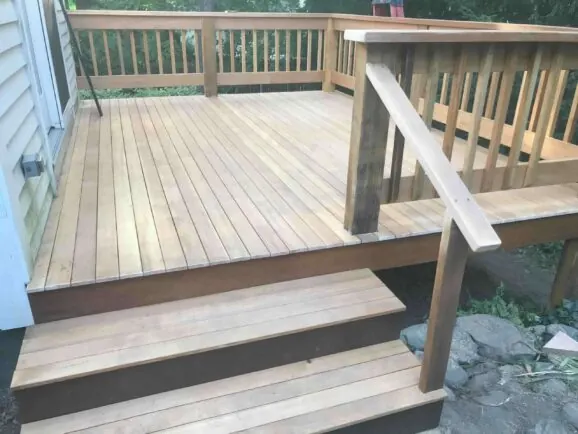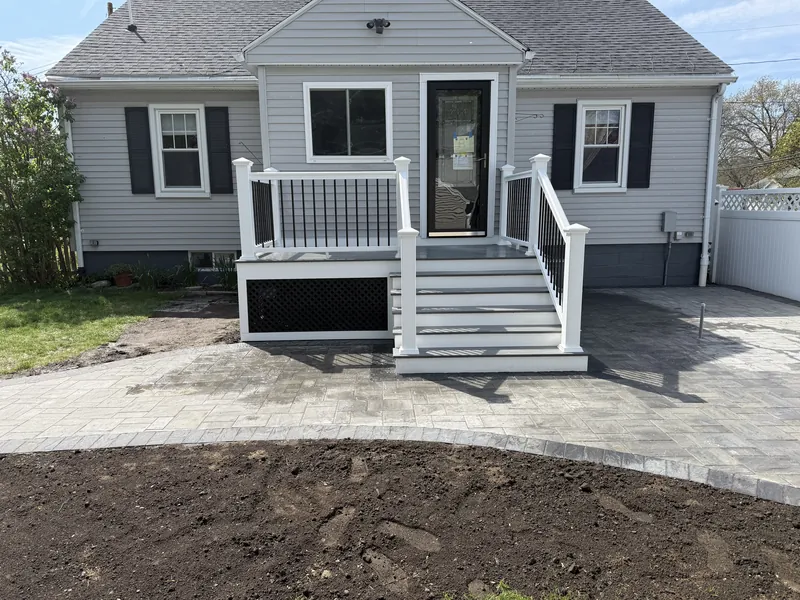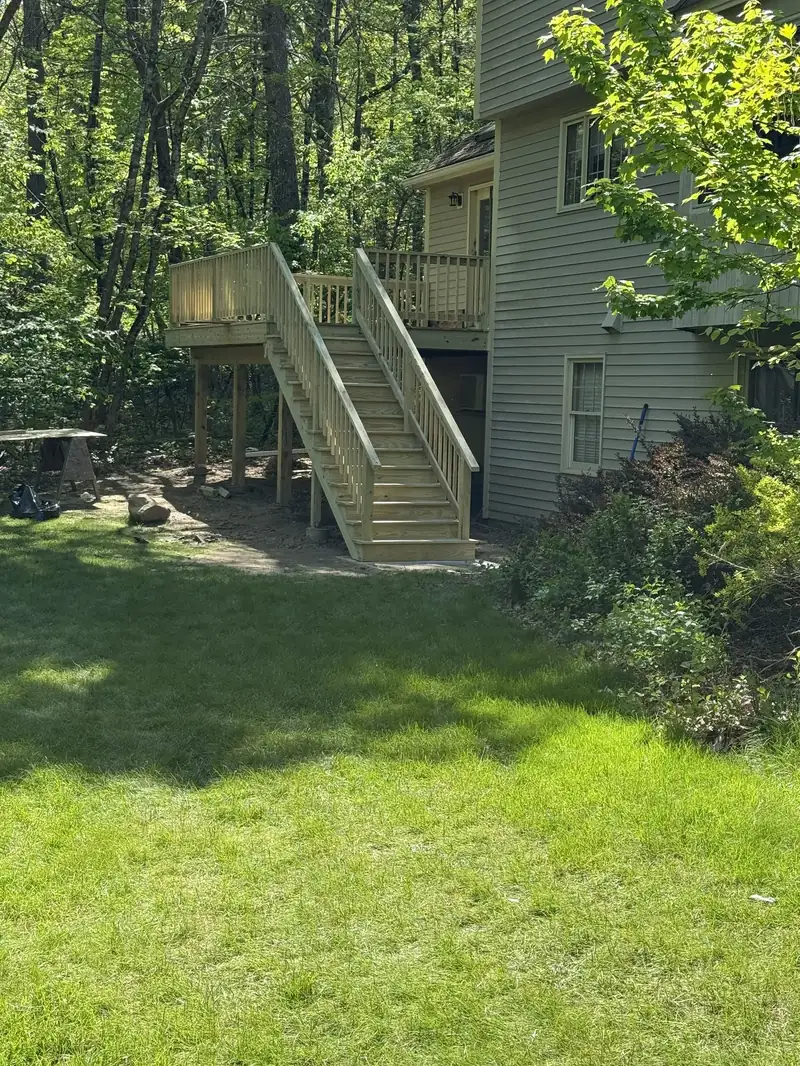
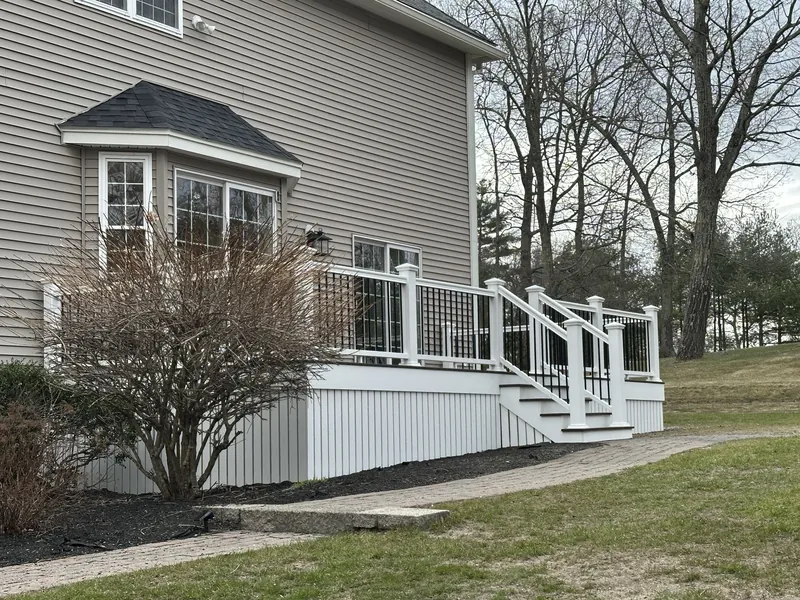
Most people pick a deck by the boards on top. But the parts that decide whether a deck lasts 10 years or 30 are the ones you never look at: the posts, the footings, the screws and the strip of flashing behind the ledger.
Here's how we think about each layer when we build a deck in Nashua or anywhere else in Southern NH, from the dirt up.
Footings come first, and they have to go below frost
Every post needs a footing that sits below the frost line. When the ground freezes it swells and pushes up, and a shallow footing goes up with it. Then it settles back in spring, a little crooked. After a few winters you get a deck that sags, gaps at the house or racks to one side.
Frost depth here is deep. Many Southern NH towns require footings at least 48 inches down, but your town's building department sets the number, so check with them. We'll confirm it when we pull the permit.
Ledge is the other local wrinkle. Dig in parts of Nashua and you hit rock before you reach depth. That isn't a dead end. Footings can be pinned to solid ledge, or the layout can shift a little to dodge it. Helical piles are another option on tough sites. What you don't do is stop short and call it good.
Pressure-treated framing, and why the rating on the tag matters
For the frame, we use pressure-treated lumber on nearly every deck. Cedar and composite don't make sense as structure, and steel framing is a specialty item. Treated wood is strong, easy to work and lasts a long time when it's the right grade.
The right grade is the catch. Treated lumber comes rated for above-ground use or ground contact. Ground-contact wood carries more preservative. Posts always need it. We'd also use it for any framing close to the soil, for low decks where air can't move underneath and for anything that stays damp, like beams under a roofline drip. Check the end tag on the lumber. If it doesn't say ground contact, it doesn't belong in or near the dirt.
Size matters as much as treatment. Beam size, joist size and spacing all come from span tables based on how far each piece reaches and how much load it carries. Our snow loads are real, so a deck that would pass in a warmer state isn't automatically right here.
Hardware and fasteners have to be rated for treated lumber
Modern treated lumber uses copper-based preservatives, and copper eats cheap steel. Plain or lightly coated screws, nails and joist hangers can corrode right through in wet conditions. It happens out of sight, inside the joint.
So every metal part in the frame should be hot-dip galvanized, a heavy zinc coating labeled for treated wood, or stainless steel. Hangers and the nails that go in them should match. Mixing a stainless screw with a galvanized hanger is a bad idea, because two different metals touching in the wet corrode faster.
We'd use stainless anywhere salt is in the picture: near a driveway that gets plowed and salted, or on a deck where you'll throw ice melt every winter.
Ledger flashing keeps water out of your house
If your deck attaches to the house, it hangs on a board called a ledger, bolted to the house's rim joist. That joint is where most deck rot starts, and the damage often shows up inside the house first.
The fix is flashing. The siding comes off where the ledger goes, a waterproof membrane goes on the wall, and metal or vinyl flashing laps over the top of the ledger and tucks behind the siding above it. Water running down the wall gets steered out over the ledger instead of behind it. Aluminum flashing shouldn't touch treated lumber directly, for the same copper reason as above. Vinyl, copper or coated flashing is the better choice.
When we look at an old deck that's pulling away from a house, missing or failed ledger flashing is one of the first things we check. Sometimes the rot has spread into the rim joist and sill, and that's a wood rot repair before it's a deck job.
Railings: wood, composite, aluminum or cable
Railing is the part of the deck you see most from inside the house, so it's worth choosing on purpose.
- Pressure-treated wood is the most affordable. It needs the same staining as a wood deck, and it doesn't take paint well for long.
- Composite or PVC railing systems come with posts, sleeves, top rails and balusters that fit together. They stay white or colored with little upkeep and pair well with composite decking.
- Aluminum railing is thin, strong and holds its finish. Black aluminum balusters with a white or wood top rail are a popular look around here.
- Cable railing keeps the view open. It costs more and needs the cables kept tight, and posts have to be stout to hold that tension.
Whatever you pick, the posts have to be fastened to the frame strong enough to stop a person falling against them. That's a structural detail, not a style choice, and it's where cheaper rail jobs go wrong.
Stairs and the decking on top
Stair stringers are usually cut from treated 2x12s. They should land on a solid base like a concrete pad or pavers, not on bare soil where they'll wick up water and sink. Treads can match your decking, though composite treads need tighter stringer spacing than wood. Your builder should know what the maker requires.
As for the decking itself, it's the last decision, not the first. Pressure-treated, cedar, capped composite and PVC all work on a good frame. We wrote a whole post on composite decking for NH homes if you're weighing that choice.
You can see finished examples on our decks page. If you want to go over materials for a deck in Nashua, call or text us at 781-248-5017 and we'll come look at the spot and walk through the options with you.